How Long Does SEO Take to Work? A Realistic Timeline
Here's something nobody in the SEO industry likes to say out loud: most businesses won't see meaningful results for at least six months. For competitive markets, twelve months is more honest.
That's not a failure of the strategy. That's how Google works.
Understanding why takes about five minutes. Understanding what's actually happening during that time is worth a lot more than the generic "it depends" answer you'll find everywhere else.
The 6-12 Month Reality
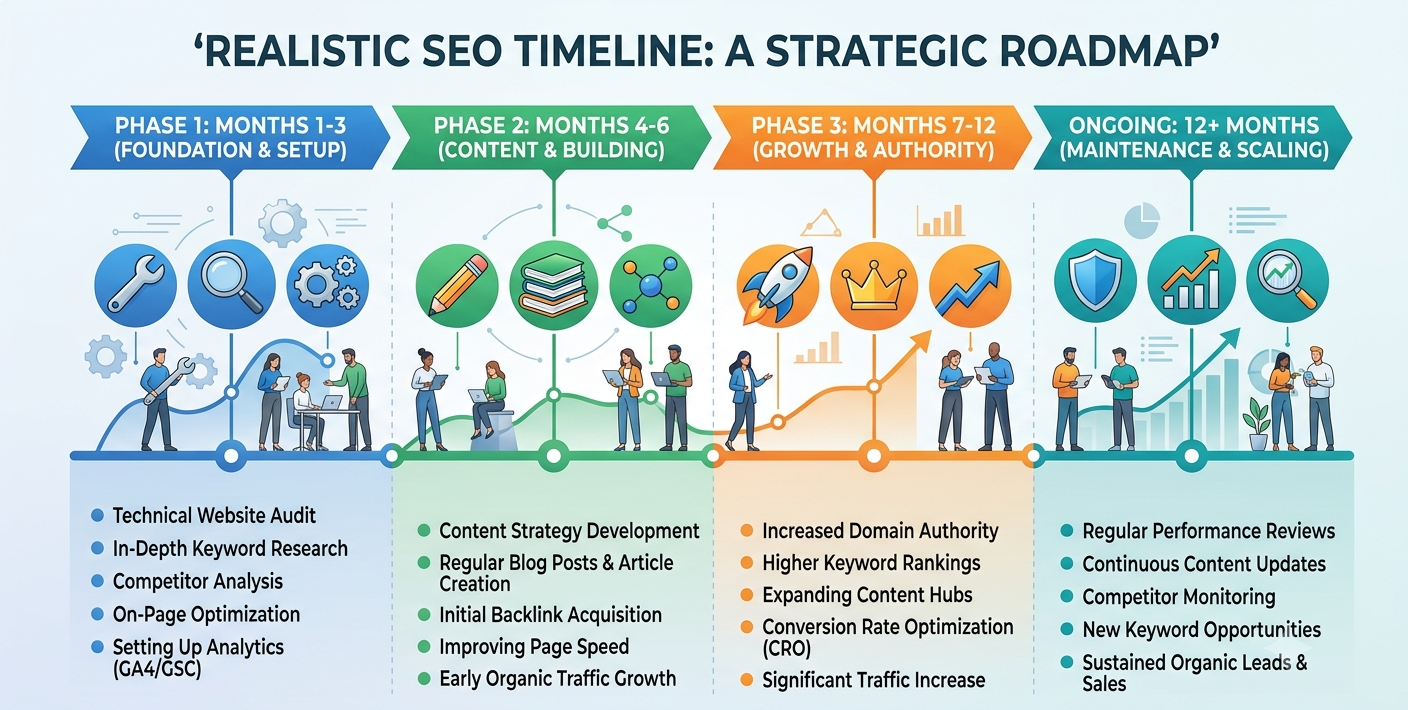
Six months is the floor for most businesses operating in real markets. Twelve months is where things typically start compounding in a way that shows up in revenue, not just a rankings report.
Google is not a directory. It builds a model of trust for every domain on the internet, and trust is earned through demonstrated consistency over time. A brand-new page doesn't compete equally with one that's been live for two years, has earned backlinks from credible sources, and has a track record of satisfying searchers. That gap closes, but it takes time.
If you want to understand how Google actually evaluates content, their Search Quality Rater Guidelines are public and worth at least a skim. Most business owners have never read them. A lot of SEO providers haven't either.
What's Actually Happening Each Month
Months 1-3: Invisible Work
The first three months are almost entirely infrastructure. Technical fixes, keyword research, on-page optimization, initial content publishing. None of it feels exciting because you can't see it working yet.
What most people don't know: new content often gets a short-term ranking bump right after it's indexed. Pages land in the top 30 or 40 for a couple of weeks, then drop back. This is sometimes called the freshness boost, and it happens because Google tests new content against real search behavior before committing to a stable ranking position. If your early numbers dip after publishing, don't panic. It's not your SEO breaking. It's Google running its evaluation.
Your real job in months 1-3 is getting Google Search Console configured, fixing anything blocking crawling and indexing, and building a content foundation actually worth ranking.
Months 3-6: First Signals
Long-tail keywords start breaking into the top 20. Impressions in Search Console climb. You'll likely see the first trickle of organic traffic, mostly from less competitive terms.
Something that rarely gets discussed at this stage: content cannibalization can quietly stall progress. If multiple pages target the same or very similar keywords, Google has to pick one to rank and often ranks neither well. A quick cannibalization audit before publishing in volume saves a lot of backtracking later. Ahrefs covers how to find it better than most.
This is also when internal linking starts paying off in a real way. Linking strategically between pages passes authority from stronger pages to newer ones and helps Google understand your site's topical structure. It's one of the highest-leverage, lowest-cost tactics in SEO and it's consistently underused. The relationship between a local SEO guide for Jacksonville businesses and its supporting cluster content is a practical example of how that architecture works.
Months 6-9: Compounding Begins
This is where the work from month one starts showing up in rankings that matter. Pages hitting the top 10 for real search terms. Traffic growing month over month. The compound effect of consistent content and links becomes visible in your data.
Worth understanding at this stage: topical authority matters more than most businesses realize. Google isn't just looking at whether a single page is optimized for a keyword. It's evaluating whether your site demonstrates depth and expertise across a subject. A site with fifteen solid, interconnected articles on a topic consistently outranks a site with one highly optimized page, all else being equal. That's the core argument for building content clusters rather than one-off posts.
Months 9-12: The Threshold
Competitive head terms start landing on page one. Organic traffic becomes a predictable, growing channel rather than an occasional trickle. Brand queries start
At this point, SEO also starts making paid ads more efficient. Stronger landing pages, better brand recognition in the SERP, and improved Quality Scores reduce cost per click if you're running Google Ads alongside organic.
Year 2 and Beyond
Businesses that hold a consistent SEO strategy for two or more years build a position that's genuinely difficult for competitors to replicate quickly. Domain authority, content depth, and backlink profiles take years to build and years to undo.
The Things Nobody Mentions
New domains face extra scrutiny. Google has never officially confirmed a sandbox period, but the SEO community has observed for years that brand-new domains often don't rank well for the first 6-12 months regardless of content or link quality. Search Engine Journal has covered this pattern extensively. If your domain is relatively new, factor it into your timeline expectations.
Rankings and traffic are not the same thing. A lot of agencies report ranking improvements on keywords nobody searches. Your rankings report can look great while organic traffic flatlines. Always cross-reference ranking data with actual impression and click data in Search Console. If a keyword isn't generating impressions, the ranking is meaningless.
Index bloat slows everything down. If your site has hundreds of thin pages, duplicate content, or low-quality URLs getting indexed, Google spreads its crawl budget across all of them. Fewer, stronger pages consistently outperform a bloated site. Running a crawl with Screaming Frog will show you what's getting indexed that shouldn't be.
Page one isn't always the actual goal. Featured snippets, People Also Ask boxes, and local map packs often drive more clicks than the first organic result. Optimizing for position zero or the local pack can deliver traffic faster than chasing the number one blue link, especially for service businesses targeting a specific geography.
Entity recognition is a hidden accelerator. Google increasingly organizes the web around entities, not just keywords. Building your brand as a recognized entity means consistent name, address, and phone number across directories, a complete and active Google Business Profile, schema markup on your site, and mentions across credible third-party sources. Sites Google recognizes as legitimate, established entities rank faster and hold rankings more reliably than sites that exist only as a domain with content on it.
How to Tell If It's Actually Working
Month-over-month organic session growth is the primary metric. Secondary metrics worth watching:
- Impressions and clicks in Search Console (leading indicator before traffic changes register)
- Keyword position trends on target terms
- Pages indexed vs. pages submitted (are your new pages being discovered?)
- Organic-assisted conversions in Google Analytics, not just last-click attribution
What not to obsess over in the first six months: domain authority scores from third-party tools. They're proxy metrics. They don't directly affect rankings and chasing them leads to link-building decisions that don't serve real goals.
Why Cheap SEO Costs More in the Long Run
A $300/month SEO package is not SEO. It's a reporting dashboard and maybe some minor on-page edits. Real keyword research, content strategy, technical auditing, link acquisition, and ongoing optimization require time that price point simply doesn't buy.
The risk isn't just seeing no results. The risk is negative results. Spammy link building, keyword stuffing, and thin content can trigger manual penalties or algorithmic demotions that take months to recover from. Recovering from bad SEO is often harder than starting from scratch.
The businesses that get the best outcomes treat SEO like the long-term investment it is, budget accordingly, and measure it against the same ROI standards they apply to every other growth channel.
Popular Marketing Articles