
How to Get More Google Reviews for Your Jacksonville Business
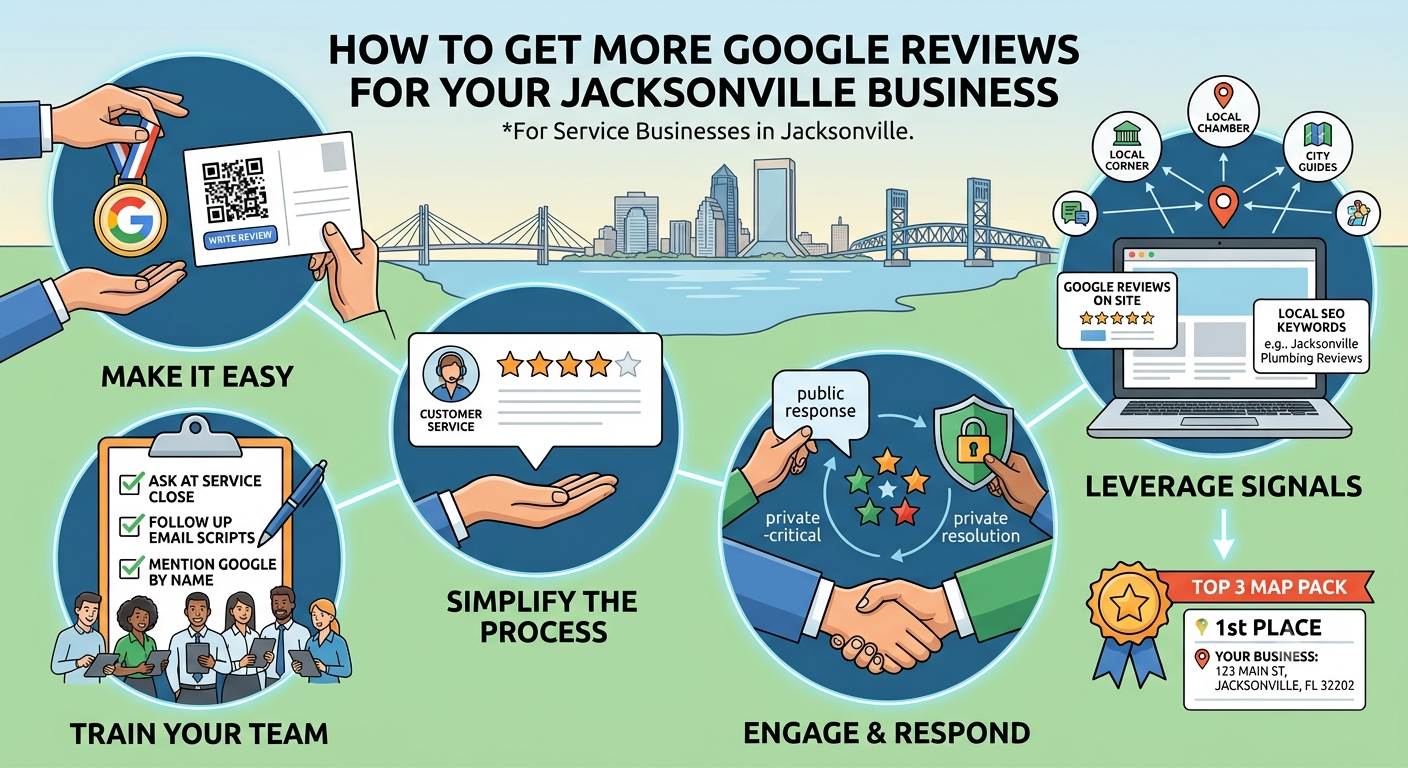
Your Jacksonville competitors are collecting Google reviews. Consistently. Every review that lands on their profile while yours sits idle is a small, compounding loss in both search rankings and local credibility. Google reviews for Jacksonville businesses aren't a nice-to-have anymore. They're one of the primary inputs that determine whether you show up when a prospect searches for your service category.
This isn't a beginner's overview of why reviews matter. It's a working guide for established service businesses that already understand the stakes and want specifics: timing, messaging, and the systems that make review generation sustainable. For context on how reviews fit into your broader local presence, the Jacksonville local SEO guide covers the full picture.
What Google Actually Does With Your Reviews
Two separate things happen when a client leaves a Google review. First, your Map Pack ranking shifts. Review count, average rating, recency, and the keywords inside the review text all feed into how Google evaluates your local relevance. A review that says "best commercial plumber in Jacksonville" is a stronger signal than "great company, five stars." Google reads the text and treats it as evidence of what your business actually does and where.
Second, your click-through rate changes. A business with 120 reviews at 4.6 stars will pull more clicks than one with 11 reviews at 4.9. Volume is a trust signal. People assume that a business reviewed by 150 clients has earned it. Eleven reviews, even perfect ones, reads as thin.
The Map Pack position gets you found. The review profile closes the gap between found and contacted. Both are driven by the same input: a consistent flow of legitimate reviews from real clients.
How to Size Up the Jacksonville Competition
Skip the industry benchmarks. They're built from national data that has little to do with your specific service category in Jacksonville.
Here's the right approach: search "[your service] Jacksonville" and click on the top three Map Pack results. Write down their review count and average rating. That's your actual benchmark, not an average pulled from a case study in another market.
For most mid-tier service categories in Jacksonville, 50 to 100 reviews puts you in the conversation. High-competition categories like legal services, dental, HVAC, and roofing often require 150 or more before you're consistently visible. Under 30 reviews, you're largely invisible in competitive searches regardless of service quality. It's also one of the core reasons businesses aren't showing up in Jacksonville Google searches even after years of operation.
When to Ask: The Variable Most Businesses Have Never Tested
Most service businesses ask at the wrong moment. Sending a review request with the invoice is the single most common mistake, and it tanks response rates. The client's attention is on the payment, not the experience.
Wait 24 to 72 hours after delivery. By then, the client has had time to see the result. The project is behind them, but the positive impression is still fresh. That's the window you're working with.
For ongoing retainers or longer engagements, tie the ask to a milestone. First report delivered. First campaign results. First outcome the client can look at and say it's working. The trigger matters as much as the timing.
How to Ask: Method and Message
Text beats email. Every time. If you have a client's cell number, use it. Text message review requests convert significantly higher than email for this specific purpose. Open rates, click rates, and actual review completion all lag behind text when you're asking for something that requires a few minutes of effort.
Make the link direct. Don't send someone to your Google Business Profile home page and expect them to find the review button on their own. Inside your GBP dashboard under "Get more reviews," Google provides a shortlink that opens the review window immediately. Use it. No searching required on the client's end, which means far less drop-off.
Three sentences. That's the ceiling. Mention the specific project. Thank them. Send the link. If you're writing a paragraph about how much reviews mean to your business, you've already lost them.
Who Gets the Ask First
Don't batch your requests. Stagger them.
A spike of ten reviews in one week, from clients in the same geographic area, triggers Google's review filter. Some may never post publicly. Others post and then disappear. Steady, spread-out volume over time draws far less algorithmic scrutiny than a push campaign tied to a slow month.
Start with clients who gave you unsolicited positive feedback. If someone replied to your project wrap-up email saying it was exactly what they needed, they've already written the review in their head. You're just pointing them to where it goes. These clients convert at the highest rate and tend to write the most specific, substantive reviews without any coaching.
What to Encourage Without Coaching Review Content
Don't tell clients what to write. Soliciting specific language violates Google's review policies and can get reviews removed from your profile.
What you can do is frame the ask around the specific engagement. "We'd love your feedback on the [service name] project we wrapped up last week" is not coaching. It's context. Clients who receive a specific reference tend to write about that engagement rather than a vague, generic comment. Keyword-rich reviews show up naturally when clients have something concrete to reflect on. The distinction is simple: you're reducing friction, not directing language.
How to Respond to Reviews
Responding to reviews is a confirmed ranking signal. Google has documented this directly. It also affects whether a prospect trusts you enough to make contact after reading your profile.
For positive reviews: drop the templates. If every response reads identically, it looks like software. Reference what the client actually mentioned. Two or three specific sentences beats a paragraph of boilerplate.
For negative reviews: respond within 24 hours. Stay factual. Acknowledge the concern without going into lengthy explanations. Then move it offline. Something like "I'd like to address this directly, please reach out at [phone or email]" is enough. Don't argue publicly. Don't justify at length. Every potential client reading that exchange is evaluating how you handle a hard situation, not just the person who complained. One composed response to a negative review does more for trust than ten responses to positive ones.
What to Avoid
Review gating means filtering clients before sending the ask so only happy ones get the review link. Google's policies prohibit it. It's also detectable through patterns in your review timeline, so it's not a risk worth taking regardless of how careful you think you're being.
Incentivized reviews, meaning anything offered in exchange for leaving one, violate both Google's terms and the FTC's endorsement guidelines. This includes indirect offers. A discount code sent in the same message as the review link crosses the line.
Fake reviews from employees, contractors, or paid services get flagged. Google's detection systems look at account history, geographic patterns, and submission timing. A suspension or mass removal sets your profile back months. For a business with a real reputation to protect, it's not a trade worth making under any circumstances.
Read Your Reviews Like Keyword Research
Once reviews are coming in consistently, slow down and actually read them.
What words do clients use without being prompted? If three separate clients mention "responsive," "quick turnaround," or a specific neighborhood in Jacksonville without any coaching, Google is reading those terms as relevance signals. Your job is to echo that language back in your Google Business Profile, in your service descriptions, and on relevant pages across your site.
Most businesses skip this entirely. The gap between the language in your reviews and the language on your website is a real optimization miss. Your clients are telling you what they searched and what they valued. That's useful data, and it costs nothing to act on.
Building a System That Doesn't Depend on Memory
A sustainable review system needs three things: a trigger, a message, and a monitoring routine.
The trigger is a specific event, project complete, milestone hit, client offboarded. The message is a short, personalized text with a direct link. The monitoring routine means checking for new reviews at least weekly and responding within 24 hours, not in a quarterly catch-up session.
If any part of this lives only in your head, it won't happen consistently. Build the trigger into your CRM so it fires automatically at the right stage. Consistent, moderate volume over 12 months builds a review profile that's genuinely hard for a competitor to close the gap on, even if they start before you do.
Reviews also happen to be one of the faster-acting local SEO inputs. If you're curious about the broader timeline, this guide on how long SEO takes to work covers what to expect across tactics. Reviews move faster than most.
Ready to see how a review strategy fits inside a full local search plan for your Jacksonville business? The complete local SEO strategy for Jacksonville businesses is the place to start, or if you'd rather talk through what that looks like in practice, our Jacksonville SEO services page is a good next step.
Popular Marketing Articles