Why Is My Website Not Getting Leads? (And How to Fix It)
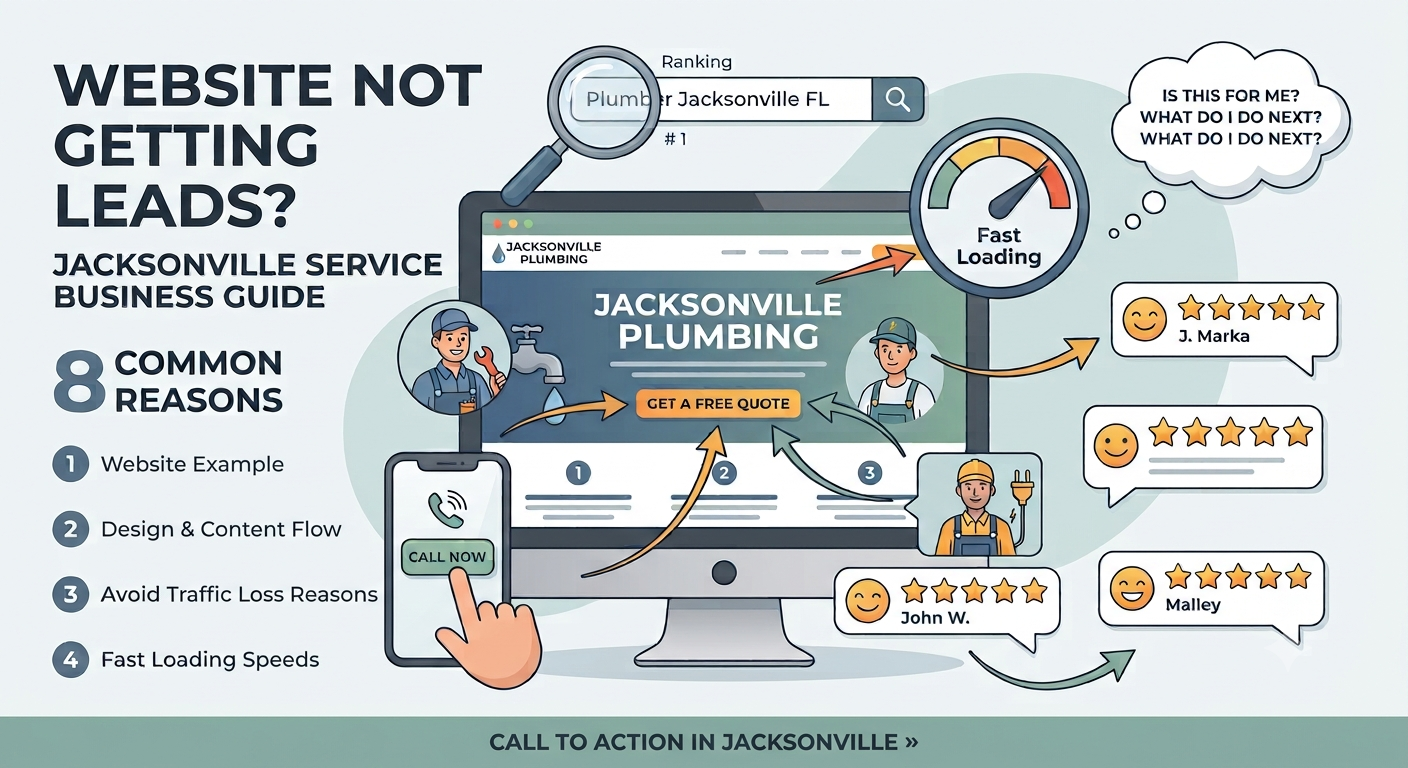
You've got a website. Maybe it looks polished. Maybe you spent real money on it. But the contact form sits empty, the phone stays quiet, and you're starting to wonder if the whole thing was a wasted investment.
It probably wasn't. But something is off. Here's what's actually happening.
The Short Answer
Your website isn't getting leads because it's either not being found, not being trusted, or not making it easy enough to take the next step. For most service businesses in Jacksonville, it's a combination of all three.
The sites that convert weren't just built to look good at launch. They were built to perform over time. There's a difference.
1. Nobody Is Finding It
The most common reason a website doesn't generate leads is simple. Traffic. A beautiful website with zero visitors converts at exactly zero percent.
If you're not ranking on page one of Google for searches your clients are actually typing, you're invisible. Most people don't scroll past the first few results. Many never scroll past the map pack at all.
For Jacksonville service businesses, this means competing against companies with older domains, more reviews, and more published content. A static five-page website won't outrank someone who has been building location-specific content for two years.
What to check: Open an incognito browser window and search your service plus "Jacksonville." If your website isn't on page one, traffic is your primary problem. Fix that before adjusting anything else on the site.
Learn how local search visibility works for Jacksonville businesses: How Local SEO Works — The Jacksonville Guide
2. Your Homepage Talks About You, Not Them
This one stings for a lot of business owners.
Most service business homepages open with the company name, a tagline about quality or passion, and a team photo. That's not what a prospect needs to see in the first three seconds.
Visitors decide instantly whether they're in the right place. If your homepage doesn't answer three questions above the fold (is this for me, can they help me, and what do I do next), they leave.
Rewrite your headline to name the problem you solve and who you solve it for. "Web design for Jacksonville service businesses that want more inbound leads" converts better than "We build beautiful, functional websites." Both say roughly the same thing. Only one speaks to what the visitor already wants.
3. There Is No Clear Next Step
A website without a clear call to action is a brochure. Brochures don't generate leads.
This doesn't mean plastering "CONTACT US" buttons on every page. It means every page should answer the question: what should someone do after reading this?
Specific calls to action outperform vague ones. "Schedule a 20-minute call" converts better than "Get in touch." "See recent projects" converts better than "Learn more." Specificity reduces friction, and friction is where you lose people.
Check whether your primary call to action is visible without scrolling on your most important pages. If someone has to hunt for it, most won't bother.
4. Your Website Loads Too Slowly
Page speed is not just a technical problem. It's a conversion problem.
Google uses load time as a ranking factor, which means a slow site gets less traffic to begin with. But even for visitors who do find you, 53 percent of mobile users will leave a page that takes more than three seconds to load.
Most service business websites in Jacksonville are running on shared hosting with uncompressed images and outdated plugins. The site looks fine on a desktop with fast WiFi. On a phone while someone is between appointments, it's a different story.
Run your site through Google PageSpeed Insights. A mobile score below 70 is a real problem. Image compression and faster hosting alone can move that number significantly.
5. There Is Not Enough Proof
Someone finding your website through search doesn't know you. They're deciding whether to trust you based entirely on what they see on the screen.
Reviews are the fastest trust signal. If your Google Business Profile has 40 reviews and your website has none of them, you're leaving your best social proof off the page people are actually reading.
Go further than a testimonials section. Named case studies, before/after results, specific outcomes, and project photos all build more credibility than a generic quote about professionalism.
For service businesses competing locally, trust signals often matter more than the quality of your copy. Mediocre copy with strong proof still converts. Strong copy with no proof rarely does.
Your Google Business Profile and your website should reinforce each other: How Local SEO Works — The Jacksonville Guide
6. Your Site Was Not Designed for How People Actually Browse
Most of your prospective clients are finding you on a phone.
Responsive design is the floor, not the goal. Real mobile optimization means tap targets large enough to use with a thumb, phone numbers that are clickable links, contact forms with three fields or fewer, and copy that doesn't require zooming.
A common failure point: a site that's technically responsive but still buries the phone number below several paragraphs of copy. On desktop, that's a minor annoyance. On mobile, that's where you lose the lead.
7. The Wrong Pages Are Getting Traffic
You might have traffic. Just not the kind that converts.
If your analytics show visitors landing mostly on blog posts, an about page, or old secondary pages, that's informational traffic. People who are researching, not ready to buy.
Conversion traffic lands on service pages with purchase intent behind it. "Landscape design Jacksonville" converts. "How to plant a backyard garden" doesn't.
Look at which pages your actual leads are coming from. If you don't have conversion tracking set up in Google Analytics 4, you're running blind. Install goal tracking so you know what's generating revenue, not just what's getting clicks.
8. You're Sending Paid Traffic to the Wrong Page
If you're running Google Ads or any paid traffic, this one costs real money.
Sending paid traffic to your homepage is one of the most common mistakes service businesses make. Your homepage is designed to orient first-time visitors. A paid landing page should be designed for one thing: converting a specific search into a lead.
If someone clicks an ad for "Jacksonville web design," they should land on a page about web design in Jacksonville with one call to action. Not your homepage. Not your about page. A purpose-built page that matches the intent of the click.
If you're running ads right now without dedicated landing pages, pause and fix that first. You're paying for traffic you're sending to the wrong destination.
What to Fix First
Here's the honest sequence.
No traffic: SEO is the priority. Everything else is secondary until people can find you. See how we approach SEO for Jacksonville service businesses.
Traffic but no leads: Start with your homepage headline, your call to action visibility, and your trust signals. Fix those three things before changing anything else.
Leads but wrong ones: Your targeting is off. Look at which keywords are driving traffic and whether the content on those pages is attracting buyers or browsers.
If you're not sure where to start or you've already tried fixing things that didn't move the needle, the issue is often the site structure itself. See how we build websites for Jacksonville service businesses.
Frequently Asked Questions
Why does my website get traffic but no leads?
Traffic without leads is typically a trust, clarity, or conversion problem. Visitors found you but didn't see enough proof that you could help them, or they weren't shown a clear next step. The homepage headline, testimonials, and primary call to action are the first three things to audit.
How long does it take for a website to start getting leads?
For organic search, most service business websites take three to six months to see meaningful traction. That timeline shortens with strong local SEO, consistent content publishing, and a well-optimized Google Business Profile. Paid traffic can generate leads faster if the landing page is built correctly.
Can a poorly performing website hurt my business?
Yes. A site that loads slowly, looks outdated on a phone, or has no visible reviews actively works against the trust you've built through word of mouth and referrals. Most prospects check your website before they call. What they find either confirms or contradicts what they heard about you.
What is the most important part of a service business website?
The page your highest-intent visitors land on. For most service businesses, that's the service page, not the homepage. A service page should name exactly what you do, explain what working with you looks like, show proof that it works, and make the next step obvious.
Do I need to redesign my whole website to get more leads?
Not always. A full redesign is sometimes the right call, but often improving your homepage message, adding stronger proof, fixing page speed, and tightening your calls to action will move the needle without starting over. An audit before a redesign is almost always worth doing first.
Want the full picture? See the complete guide: Website Design for Jacksonville Businesses: The Complete Guide