Should I Build My Own Website or Hire a Web Designer?
The question sounds simple. The answer depends entirely on what you need your website to actually do.
If you need an online presence so people can find your phone number, a DIY builder will get you there. If you need your site to bring in leads, rank in local search, and convert visitors into paying clients, the math looks very different.
Here is what most comparisons leave out.
What DIY Website Builders Actually Include
When you sign up for a website builder, you get a template, hosting, and a domain. Everything else falls on you.
That means writing your own copy, selecting and editing photos, making every design decision, configuring mobile layout, and diagnosing why the page loads slowly on a Thursday afternoon for no apparent reason. Most people underestimate how much work goes into making a site feel intentional rather than assembled from parts.
The builder handles the infrastructure. You handle everything that makes a site work for your business.
The Time Cost Nobody Talks About
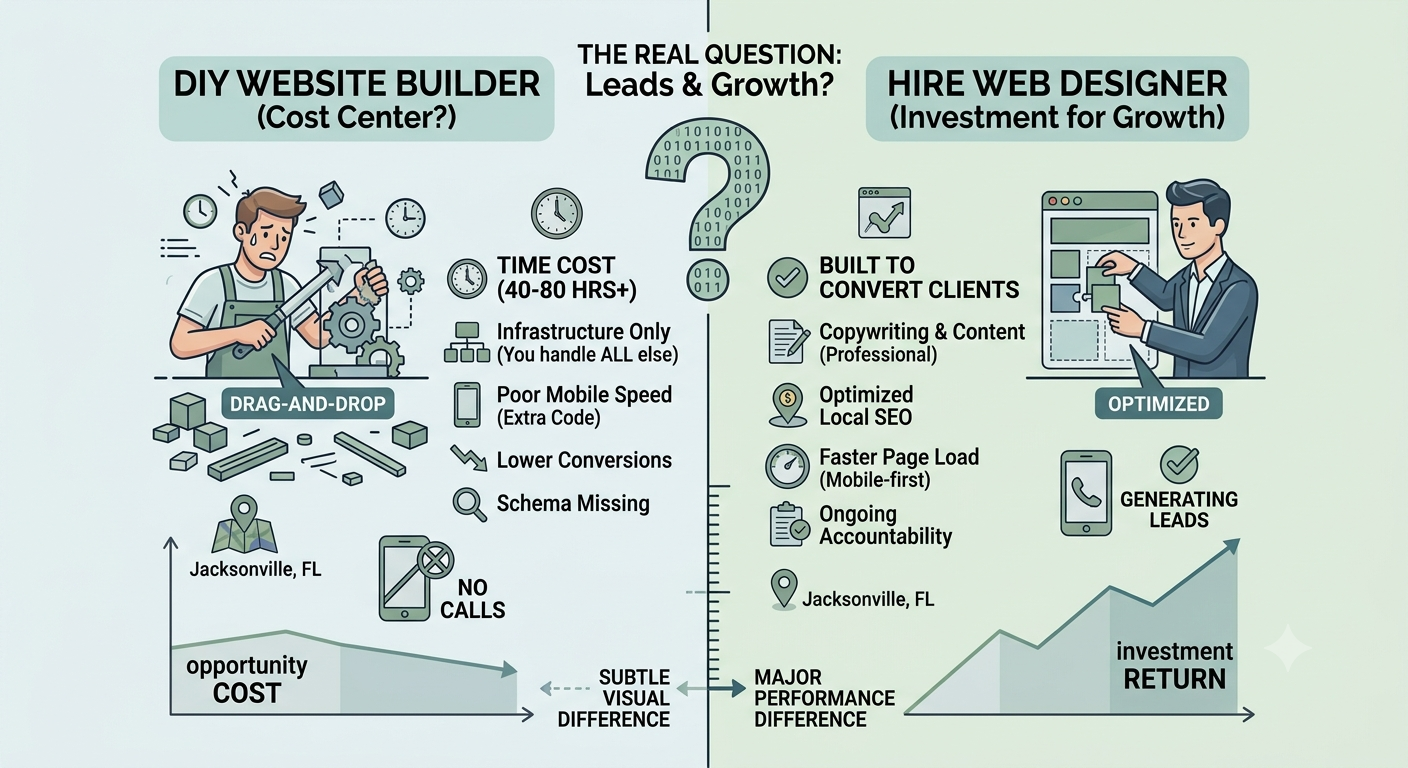
Most service business owners spend 40 to 80 hours building a site from scratch on a DIY platform, and that assumes things go smoothly.
Think about your effective hourly rate. Multiply that by 60. That is the actual price of a DIY website, before you factor in ongoing updates, troubleshooting, and the time you will spend trying to figure out why your contact form stopped routing to the right inbox.
For an established service business in Jacksonville, those are not spare hours. They are hours pulled from client work, sales conversations, and the operations you are already managing.
What Most DIY Sites Cannot Do
Drag-and-drop builders are built for ease of use, not for performance. That trade-off has real consequences.
Local search visibility is limited. Most DIY platforms do not support the technical SEO structure that helps a Jacksonville service business rank for specific searches in their area. If showing up when your buyers are searching matters to your business, this is a significant ceiling. Our local SEO guide for Jacksonville businesses covers what it actually takes to rank in your service area.
Page speed is often poor. DIY builders load templates with extra code that slows everything down. More than half of web traffic is now mobile, and mobile visitors leave quickly. A site that takes four seconds to load loses a meaningful share of its visitors before they read a single word.
Conversion rates are lower. A site that looks finished is not the same as a site built to convert. Professionally structured sites are designed around how buyers move through a decision, not just how the homepage looks. If your site is getting traffic but not generating calls, this breakdown of why websites stop generating leads covers the most common structural problems.
Schema markup is typically missing. Structured data helps your content appear correctly in search results and AI-powered tools. Most DIY platforms offer no practical way to add it, which is increasingly a disadvantage as search behavior shifts.
When DIY Actually Makes Sense
To be fair, there are situations where building your own site is the right call.
- You are just starting out with no budget for professional design
- Your business does not rely on your website for leads
- You have a design or marketing background and can treat it as a real project
- You need something temporary while a professional site is in development
If none of those describe where you are, the math shifts quickly.
What Hiring a Web Designer Actually Gets You
A professionally built website is not a better-looking version of a DIY site. The structure is different from the start.
Pages are built around how your buyers make decisions. Copy is written to move someone from "I found this site" to "I want to call." Load speed is optimized. Local SEO structure is built in. And someone other than you is accountable for the result.
One thing most business owners do not realize: if you bring a professional designer in later to fix a DIY site, they often end up rebuilding from scratch anyway. Most DIY platforms lock you into their ecosystem, making migration expensive and time-consuming. Starting with a solid foundation costs less in the long run.
If you want to understand what professional web design runs and what drives the price, this breakdown of website costs for service businesses is a good place to start. And if you want to see what a Jacksonville-specific approach looks like, our web design services page covers how we build sites for established local businesses.
The Real Question
It is not whether you can build your own website. You probably can.
The real question is what you need your website to do. If the answer is generate leads, rank in local search, and support the growth of a business you have already invested years building, a DIY site rarely gets you there.
A website that looks finished but generates no leads is not a starting point. It is a cost center. For most established service businesses, the time and opportunity cost of building and maintaining a DIY site exceeds what professional design costs within the first year.
If you want to know whether your current site is structured to perform, this post on what every service business website actually needs is a practical starting point.
Frequently Asked Questions
Is Wix or Squarespace good enough for a service business?
For a basic online presence, yes. For a site that ranks in local search, loads quickly on mobile, and consistently converts visitors into leads, both platforms have structural limitations that are difficult to work around. If your business depends on your website for growth, those limitations matter.
How much does it cost to hire a web designer in Jacksonville?
Most professionally built websites for service businesses in Jacksonville range from $3,000 to $15,000 depending on size and complexity. We covered the full breakdown in this guide to website costs for service businesses.
Can I start with a DIY site and hire someone later to improve it?
You can, but it often ends up being more work than starting fresh. Most DIY platforms lock you into their ecosystem, which makes migration expensive. A professional designer brought in to fix a DIY site frequently rebuilds from scratch anyway.
What is the difference between a DIY website and custom web design?
A DIY site uses a pre-built template you customize within the limits of the platform. Custom web design is built around your specific business goals, your buyers, and the searches you need to rank for. The visual difference is sometimes subtle. The structural and performance difference is not.
How long does it take to build a website with a professional designer?
Most projects take four to twelve weeks depending on scope and how quickly content and feedback come in. We covered the full breakdown in this guide to website build timelines.
Want the full picture? See the complete guide: Website Design for Jacksonville Businesses: The Complete Guide
Popular Marketing Articles