What Your Marketing Data Is Actually Telling You (And Why Most Service Businesses Never Look)
Your marketing data is telling you exactly what is working and what is draining your budget. The problem is most service businesses never look at it long enough to hear it.
If you are running ads, posting content, or investing in SEO and you cannot answer the question "where did my last 10 clients come from," your data is not the problem. Your relationship with it is.
This post breaks down what your marketing metrics are actually signaling, what to do about it, and why a Jacksonville service business used this exact framework to generate 898% more pipeline value in under a year.
What Does Marketing Data Actually Tell You?
Marketing data tells you which channels are driving real revenue, which are creating the illusion of activity, and where your budget should shift. Most business owners are only looking at vanity metrics like followers and impressions. The data that matters is traffic source, lead quality, cost per acquisition, and conversion rate by channel.
If you have been investing in content marketing, paid ads, or SEO without a way to measure which one is actually producing clients, you are making budget decisions based on gut feeling. That gets expensive fast.
Why Do Most Service Businesses Ignore Their Marketing Data?
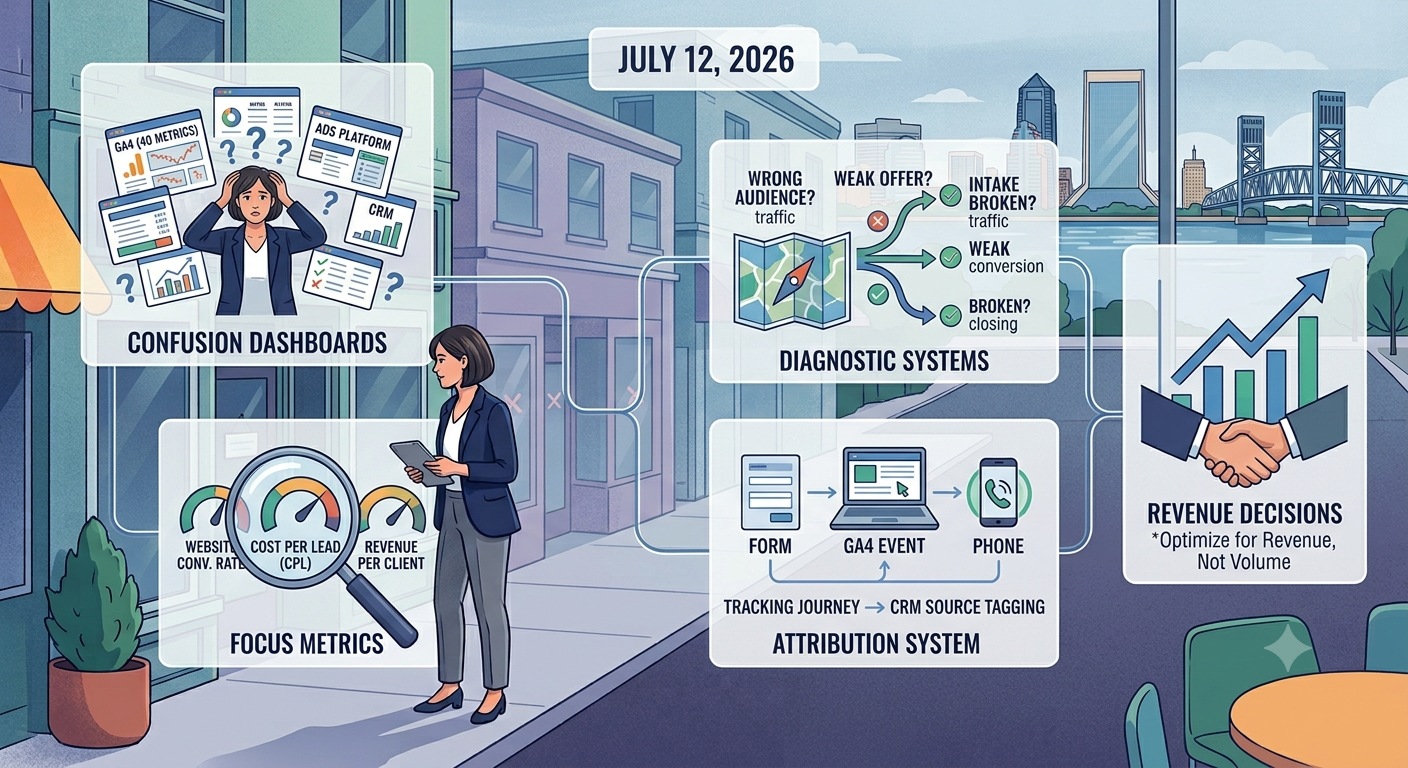
Most service businesses ignore their marketing data because it feels overwhelming, the dashboards are confusing, and no one has translated the numbers into decisions. When data does not connect directly to revenue, it gets ignored. The issue is not a lack of information. It is a lack of interpretation.
Here is what this looks like in practice: A Jacksonville-based service business came to us running paid ads, posting to social media weekly, and sending a monthly email. They had data everywhere. Google Analytics, Meta Ads Manager, an email platform. None of it was connected to anything. No goals. No key events. No way to know which of the three was worth keeping.
Within 60 days of auditing their data and setting up proper tracking, they cut two underperforming channels, doubled down on what was working, and saw a measurable increase in qualified leads within the quarter.
Which Marketing Metrics Actually Matter for Service Businesses?
The marketing metrics that actually matter for service businesses are traffic source, lead source, cost per lead, conversion rate from lead to client, and average client value by channel. Follower counts, likes, and impressions are not business metrics. They are attention metrics, and attention does not pay invoices.
- Traffic source- Where are people coming from before they contact you?
- Lead source- Which channel did your paying clients find you on?
- Conversion rate- What percentage of website visitors actually reach out?
- Cost per lead- How much are you spending to generate each inquiry?
- Average client value- Which channel brings in the highest-value clients?
If you cannot answer these five questions right now, your marketing is running on instinct. That works until it does not.
What Is a High Bounce Rate Telling You?
A high bounce rate is telling you that people are landing on your page and leaving without taking any action, which usually means one of three things: the wrong people are arriving, the page does not match what they expected, or the page is not giving them a reason to stay. A bounce rate above 70% on a core service page is worth investigating immediately.
Common causes include:
- Paid traffic sent to a generic homepage instead of a targeted landing page
- Slow load times on mobile
- Hero copy that speaks to the business owner, not the client
- No clear next step above the fold
This is one of the first things we look at in a Fractional CMO engagement. A bounce rate problem is almost never just a design problem. It is a strategy and messaging problem that shows up in the numbers first.
How Do You Know If Your SEO Is Actually Working?
You know your SEO is working when you see consistent growth in organic impressions, clicks from non-branded search terms, and an increase in qualified leads that reference finding you on Google. Ranking for keywords is not the finish line. Ranking for keywords your clients actually search is.
Google Search Console is your starting point. Look at your top queries, average position, and click-through rate. If you are showing up in searches but not getting clicks, your title tag or meta description is the problem. If you are not showing up at all, your SEO strategy needs to align more closely with what your clients are actually asking.
For Jacksonville service businesses specifically, local intent searches carry a lot of weight. Our local SEO guide for Jacksonville breaks down exactly how to show up when buyers in your market are actively looking.
What Should You Do When Your Marketing Is Not Producing Results?
When your marketing is not producing results, the first step is to stop adding more tactics and start auditing what you already have. Most service businesses that are not seeing returns are not failing because they are doing too little. They are failing because what they are doing is not connected to a clear strategy.
A data audit typically reveals one of three problems:
- Tracking is broken- Goals are not set up, key events are not firing, and there is no way to measure what is actually converting.
- The wrong audience is arriving- Paid traffic or organic content is attracting people who were never going to buy.
- There is no system for follow-up- Leads are coming in but not being nurtured, so they go cold before ever becoming clients.
Fixing these three things alone can transform what looks like a marketing problem into a predictable growth system.
How a Jacksonville Service Business Added 898% More Pipeline Value
A Jacksonville service business added 898% more pipeline value by stopping activity-based marketing and switching to a strategy-first approach with proper tracking in place. They went from guessing which channels worked to knowing exactly which ones to scale, and they did it in under 12 months.
The shift was not about spending more. It was about understanding what the data was already saying and having someone translate it into decisions. That is what a fractional CMO does differently than a freelancer or an in-house junior marketer: the focus is always on strategy, not just output.
When Does It Make Sense to Bring in Outside Help?
It makes sense to bring in outside help when you have been investing in marketing for more than six months without a clear picture of what is working, when your data is fragmented across platforms with no one connecting the dots, or when you are scaling and cannot afford to make expensive guesses.
A fractional CMO can come in at the strategic level, audit your current data, build a measurement framework, and align your channels around the outcomes that matter most. You get senior-level thinking without a full-time hire.
If you are a Jacksonville service business ready to stop guessing and start making data-driven decisions, here is how we work together or reach out directly to start the conversation.
Frequently Asked Questions About Marketing Data for Service Businesses
What marketing metrics should a service business track?
Service businesses should track traffic source, lead source, cost per lead, conversion rate by channel, and average client value. These five metrics connect your marketing activity directly to revenue, which is the only number that matters.
How do I know if my marketing is actually working?
Your marketing is working if it is generating qualified leads at a cost that makes business sense and those leads are converting into clients at a measurable rate. If you cannot answer that question with data, your tracking needs to be fixed before your strategy does.
What does a high bounce rate mean on a service page?
A high bounce rate on a service page means visitors are leaving without taking any action. It usually signals a mismatch between what brought them to the page and what they found when they arrived. Fixing the copy, the page speed, or the traffic source typically resolves it.
How long does it take to see results from SEO?
Most service businesses see meaningful movement in organic traffic within three to six months of a consistent SEO strategy. Rankings can appear sooner, but sustained traffic growth that converts into leads typically takes at least 90 days of content and technical optimization.
What is the difference between a vanity metric and a business metric?
A vanity metric makes your marketing look active, like follower counts, impressions, or likes. A business metric tells you whether your marketing is generating revenue, like lead source, conversion rate, and cost per acquisition. Most service businesses focus too heavily on the former and not enough on the latter.
Popular Marketing Articles